
IMDEA Energy brings science closer to the public at the Madrid es Ciencia Fair
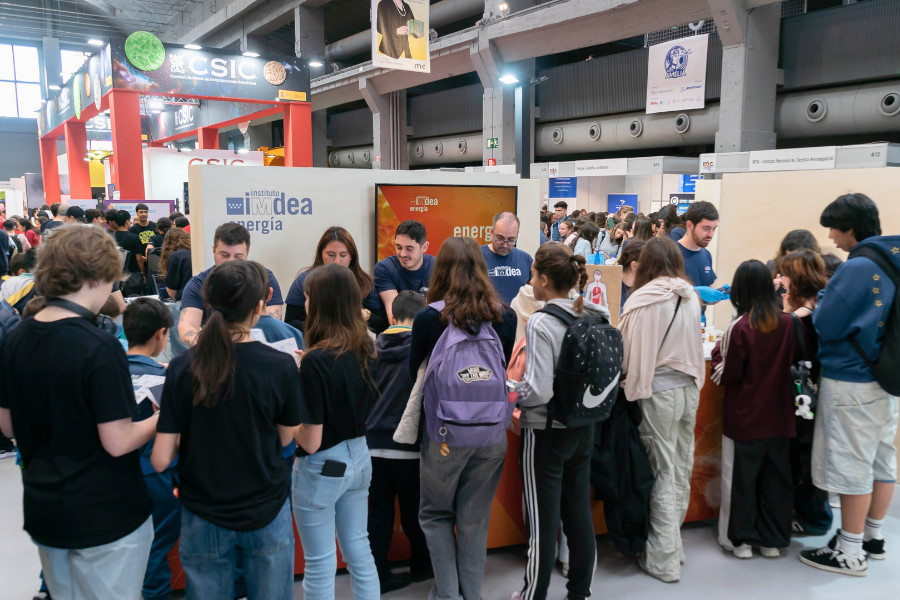
IMDEA Energy has once again taken part in the Madrid es Ciencia Fair, held for the first time at La Nave in Madrid. This flagship science outreach event brings together research centers, universities, and organizations committed to bringing science closer to society. Over the course of the three-day event, the institute’s team developed a wide range of interactive activities aimed at all audiences, with the goal of inspiring scientific vocations and showcasing the impact of research on everyday life.
Through dynamic workshops and hands-on demonstrations, visitors were able to explore key concepts in areas such as energy, advanced materials, chemistry, biotechnology, and environmental technologies.
Among the activities carried out, attendees discovered the fundamental role of catalysts in everyday processes, as well as the optical properties of nanomaterials through proposals that combined science and creativity. They also learned about nanomedicine and nanomotors, gaining a simple understanding of how future medicines might work.
In the field of energy and materials, experiments were conducted to test the conductivity of various everyday liquids, as well as activities that allowed participants to compare the performance of batteries and supercapacitors through practical demonstrations. In addition, materials capable of changing color were showcased, sparking participants’ interest in the advanced properties of new materials.
On March 20, the activities focused on chemistry and environmental technology. Visitors observed water filtration processes using activated carbon to remove contaminants, learned how materials such as zeolites are present in everyday products, and attended demonstration reactions illustrating catalytic processes. They also took part in interactive activities focused on proper waste separation and management, along with playful initiatives that made scientific concepts more accessible.
March 21 was dedicated to biotechnology and renewable energy. In the biotechnology area, attendees participated in experiments related to gas production using yeast, pH measurement, plate inoculation, and DNA extraction. Meanwhile, the High-Temperature Processes Unit (AT) introduced visitors to the operation of concentrated solar power plants through experiments and virtual reality experiences. This activity helped explain how mirrors concentrate solar radiation to generate high temperatures and produce energy, as well as offering an immersive exploration of how these key installations function in the energy transition.
IMDEA Energy’s participation in Madrid es Ciencia reinforces its commitment to science outreach and knowledge transfer, bringing research closer to society and highlighting the fundamental role of science in building a more sustainable future.


