

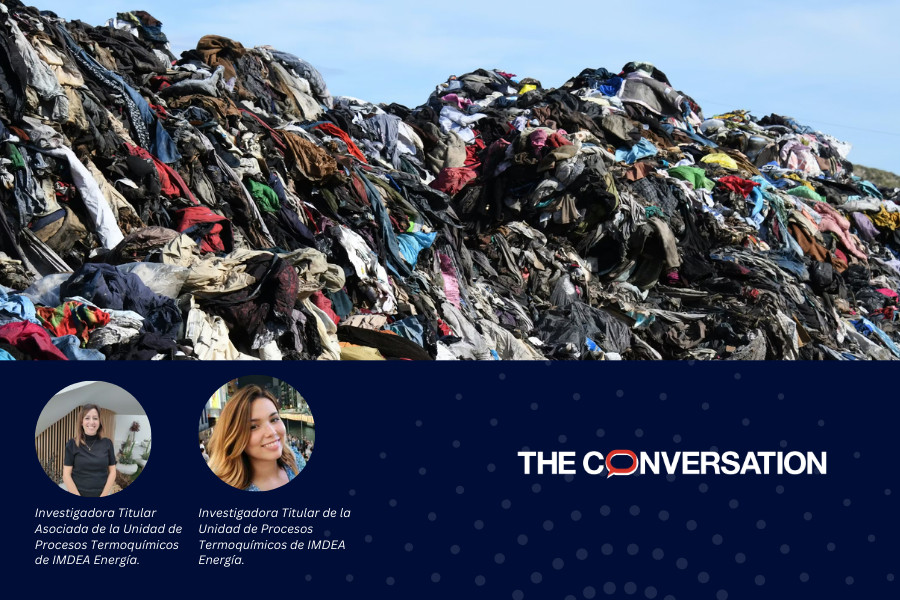
We can turn the clothes we throw away into fuel and other resources to prevent them from ending up in landfills
Did you know that, on average, we only wear our clothes seven times before discarding them? The textile industry is one of the sectors with the greatest environmental impact: it generates around 10% of global CO₂ emissions—more than all transatlantic flights combined—and consumes enormous amounts of water. Producing a single cotton T-shirt requires about 2,700 liters, equivalent to the amount of water a person drinks over two and a half years.
In recent years, these problems have worsened due to the phenomenon of fast fashion, a model based on producing large quantities of cheap clothing at high speed, following almost immediate trends. We buy more garments, more cheaply and more frequently, but at the cost of increasing environmental impact.
Recycling more textiles would be part of the solution, but it is not easy. In Spain, each person generates around 20 kg of textile waste per year, and only 1% is recycled. The rest ends up in landfills, forming veritable mountains of clothing.
How are the clothes we discard recycled?
The most widespread option is mechanical recycling, which shreds and breaks down garments to obtain new fibers. However, this process shortens and weakens them, reducing their quality and limiting their use in making new clothing. In addition, it is not very effective with blended fabrics, which are very common today.
Chemical recycling allows fabrics to be broken down into their basic molecules to rebuild the original fibers; it is like taking a puzzle apart piece by piece and putting it back together again. This makes it possible to recover materials similar to the original ones. This method is more developed for synthetic fibers such as polyester, using solvents, temperature, and pressure to break their chains and obtain the starting components, which are then purified and transformed into new fibers. Although promising, its environmental impact and its limitations with mixed fabrics or natural fibers prevent it from being a universal solution.
In this context, pyrolysis emerges as an alternative with great potential, as it allows the treatment of garments made from complex fabrics without prior separation of fibers.
How to turn fabrics into fuels
The process involves heating textile waste to high temperatures in the absence of oxygen. Instead of burning, the material decomposes into three fractions: a gas, a solid, and a liquid.
The gas can be used as fuel to provide the heat required by the process itself. The carbon-rich solid has multiple applications: as a solid fuel, a soil improver, or a filtering material to remove pollutants from liquid or gaseous streams. And the liquid, known as pyrolytic oil, is a complex mixture of organic compounds whose composition depends on the original fabric and which can be upgraded to obtain fuels or chemical products.
At the Thermochemical Processes Unit of IMDEA Energy, we have been working for years on the pyrolysis of different types of waste—organic, agricultural, forestry, plastic, or tires—with the aim of producing oils that can be transformed into liquid fuels or compounds similar to petroleum derivatives.
However, pyrolytic oil is very complex. It contains numerous compounds and, unlike crude oil, has significant amounts of oxygen, nitrogen, chlorine, or sulfur. These elements make its direct use as a fuel and its integration into industrial processes more difficult.
To overcome this limitation, the HYPY-CAT project explores an innovative solution: low-pressure catalytic hydropyrolysis. This process carries out pyrolysis in the presence of hydrogen, which helps remove unwanted elements and improves the quality of the oil obtained. By operating at low pressure, it also reduces operating costs.
New catalysts
A key element is the catalyst, which facilitates the breaking of long polymer chains and promotes the removal of unwanted compounds. The project proposes a special type of zeolites—porous solids similar to sponges with small channels through which molecules must pass in order to react.
Zeolites are excellent catalysts, but their pores are often so small that many molecules from textile waste cannot access them due to their large size. Imagine a truck or a bus trying to pass through a very narrow street. Our proposal is to create “avenues,” that is, larger pores that allow bulky molecules to enter. Once inside, they can be transformed into smaller ones capable of penetrating narrower pores and completing the desired reactions.
With this initiative, we are opening a new pathway to recycle textile waste, reduce its environmental impact, and turn it into useful resources for industry, moving toward a true circular economy in the textile sector.