

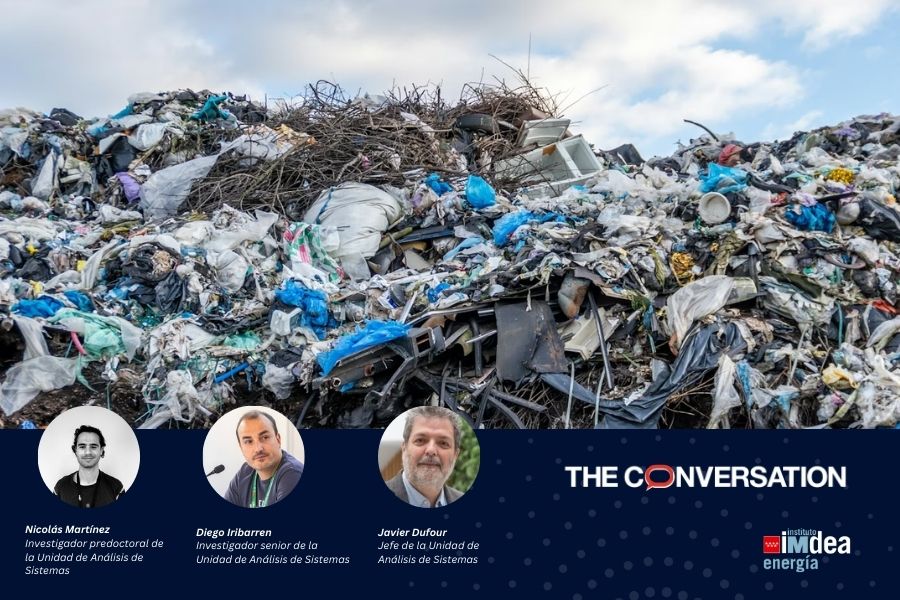
What the Madrid case teaches us about waste management: treating it is not enough
By 2035, only 10% of municipal waste will be allowed to end up in landfill, according to the target set by the European Parliament. With fewer than ten years remaining, Spain is starting from a position far removed from this goal: nearly half of its waste still ends up in landfill.
Bridging the remaining gap will require a major effort, particularly in densely populated municipalities, where waste treatment facilities are necessarily located close to residential areas.
Examples from other European countries
In some parts of Europe, this target has already been achieved by combining different approaches. The Netherlands is a clear example of the intensive use of incinerators. So much so that at certain times it has had to import waste from other places to keep its plants operating.
There are other cases (for example, the German model) that rely on highly demanding source-separation systems, accompanied by public policies aimed at reducing contamination. Contamination refers to materials placed in the wrong bin, which hinder recycling. Even in these models, however, thermal treatment of residual waste—that is, waste that cannot be recycled or recovered in the initial treatment stages—is not dispensed with. The difference lies less in the technologies available than in where the greatest efforts in system management are concentrated.
Spain presents very diverse realities, ranging from small rural municipalities to large metropolitan areas, with combinations of different strategies and technologies. In general terms, incineration is less common than in northern European countries and is concentrated mainly in large cities.
The case of Madrid
Madrid is particularly interesting because it has a technologically complex treatment system in which recycling plants, composting, anaerobic digestion, landfill, and incineration coexist.
Today, Madrid is still far from the target set by the European Union: around 45% of the city’s waste still ends up in landfill. A large share of the reduction achieved depends on the Valdemingómez incinerator operating practically at the limit of its capacity.
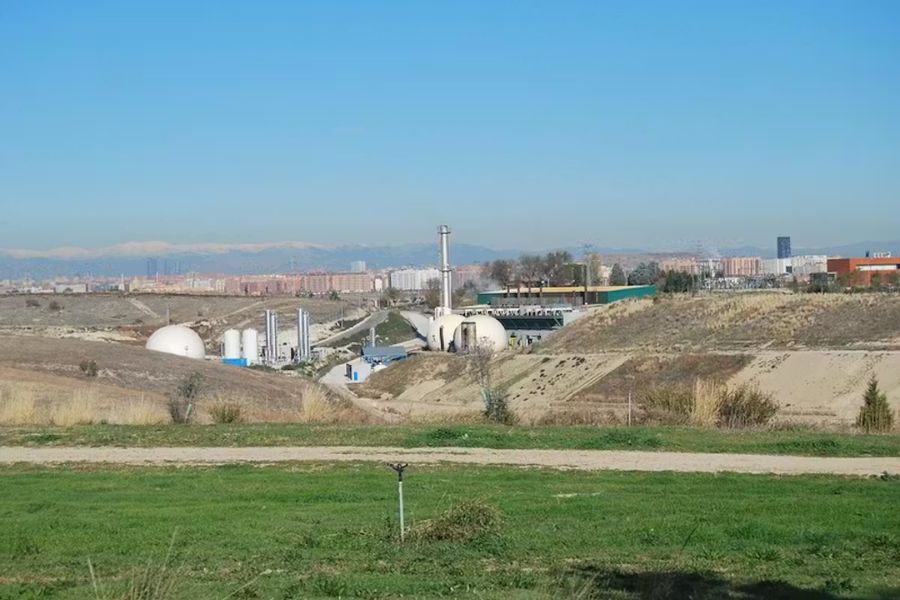
Parque de gestión de residuos de Valdemingómez. IES MANUEL GARCÍA BARROS A ESTRADA - PONTEVEDRA/Flickr, CC BY-SA
Moreover, the planned closure of the incinerator around 2035 makes it necessary to consider alternatives. Doing away with it without an equivalent solution would imply an immediate increase in landfill disposal, while replacing it with emerging technologies such as gasification or pyrolysis—the decomposition of waste at high temperatures in the absence of oxygen—opens up a debate as to whether the problem can be solved solely through treatment.
For all these reasons, Madrid constitutes a revealing case study for assessing the extent to which a system supported by advanced treatment technologies can achieve a reduction in landfill disposal without profound changes in waste generation and in the public policies that shape the emergence of residual waste.
Is it more effective to eliminate waste or to prevent and recycle it?
This tension between technology and prevention is typical of waste management, where responses have relied mainly on treatment solutions, with less ambitious progress in prevention, reuse, and high-quality recycling strategies.
In this regard, a study led by researchers from the Systems Analysis Unit at IMDEA Energía has shown that even if the incinerator were replaced with advanced treatment technologies such as gasification and pyrolysis, a waste management system like Madrid’s would face a structural limit of around a 40% landfill rate under optimistic separation scenarios.
Despite this limit—and although other solutions are needed—the incorporation of these technologies is of interest, as they expand the system’s functionality by helping to meet demand for high-value products such as hydrogen or advanced circular fuels.
Studies identify effective measures to structurally reduce the upstream production of non-recyclable waste: taxation that penalizes complex packaging, more demanding extended producer responsibility, or ecodesign requirements—that is, designing products from the outset to generate less impact and to be easier to dismantle and recycle.
These measures require national or European regulatory frameworks, as they directly affect product design and marketing. Others, however, can be activated at the local level, once those frameworks are in place, through the design of economic instruments, more demanding collection systems, or incentives linked to waste quality.
In this context, Madrid reintroduced its municipal waste tax in 2023, in application of the “polluter pays” principle. All municipalities with more than 5,000 inhabitants had until 2025 to implement a waste collection fee.
Although the obligation to introduce this fee stems from national legislation, its design at the municipal level largely determines its capacity to change behavior and reduce contamination.
Identifying causes to apply solutions
Ultimately, reducing landfill disposal is not just a matter of choosing the “best” technology, but of advocating for a comprehensive approach that addresses the root causes of the problem. Experience shows that without ambitious public policies targeting prevention, product design, and the quality of the waste we generate, even the most advanced solutions will eventually hit the same walls.
The good news is that management support tools do exist and are well documented. These include mathematical models to guide waste management systems toward more sustainable performance, as well as strategies to promote public policies that reduce contamination and residual waste. Combining these tools with technological innovation makes it possible not only to meet targets, but also to move toward a fairer waste management model—one capable of contributing to the energy transition and aligned with the principles of the circular economy.