




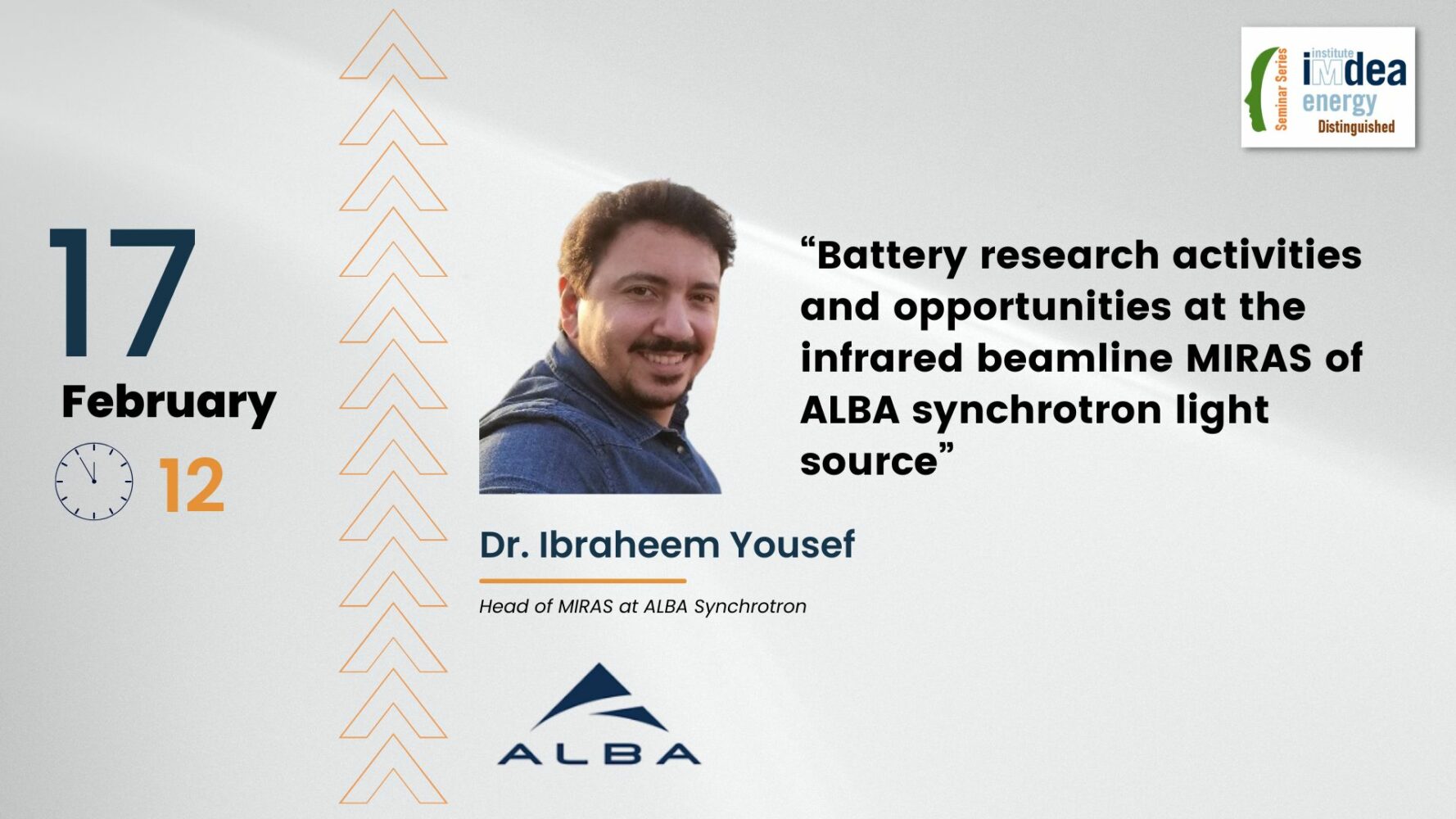
Distinguished seminar «Battery research activities and opportunities at the infrared beamline MIRAS of ALBA synchrotron light source»
Bio
Ibraheem Yousef is the head of the Infrared Microspectroscopy Beamline (MIRAS) at the ALBA Synchrotron Light Source in Barcelona. He obtained his Ph.D. from Pierre and Marie Curie University (Paris VI), France, with doctoral research carried out at the SOLEIL Synchrotron.
From 2011 to 2014, he served as Beamline Scientist and head of the Infrared Microspectroscopy Beamline at the SESAME Synchrotron in Jordan. His research focuses on synchrotron-based Fourier-transform infrared (SR-FTIR) microspectroscopy and its applications in materials science, life sciences, and energy-related studies.
At MIRAS, he is responsible for the development of advanced experimental capabilities, including operando and in situ FTIR microspectroscopy approaches for energy-related materials, with particular emphasis on electrochemical systems and battery research. He oversees the operation and upgrade of the beamline facilities and contributes to the development of the infrared microspectroscopy user community, fostering national and international collaborations in materials science and energy research.
Abstract
Synchrotron-based infrared microspectroscopy has emerged as a powerful tool for probing chemical dynamics and interfacial transformations in battery materials. At the MIRAS beamline of the ALBA Synchrotron, a rapidly growing research program is leveraging the unique brightness and spectral range of synchrotron IR radiation to address long-standing challenges in the understanding of electrode–electrolyte reactivity, solid–electrolyte interphase (SEI) formation, and degradation pathways in both ex-situ and operando conditions.
The coupling of Fourier Transform Infrared microspectroscopy (SR-µFTIR) with the high flux density of the ALBA infrared source—100 to 1000 times brighter than conventional thermal emitters—enables chemical imaging at micrometre-scale resolution with excellent signal-to-noise ratios. The beamline design, together with multiple detector configurations optimized for Mid-IR to Far-IR operation (∼1–100 μm), allows simultaneous access to fundamental vibrational modes of complex organic, polymeric, and inorganic components relevant to metal-ion and metal-anode batteries.
Recent studies at MIRAS have demonstrated the ability of SR-FTIR to resolve the chemical evolution of SEI layers, track electrolyte decomposition routes, and identify ion-specific interactions governing passivation and stability in systems ranging from Ca, Mg, and Na metal anodes to organic redox polymers. Building on these advances, MIRAS is now entering a new phase of development toward true operando SR-µFTIR capabilities, enabling time-resolved diagnostics under realistic cycling protocols, controlled atmospheres, and tailored electrochemical environments.
This contribution will present an overview of the current and emerging opportunities for battery research at MIRAS, highlighting representative user results, recent technical upgrades, and future directions.
-
00
days
-
00
hours
-
00
minutes
-
00
seconds