

Distinguished Seminar: “Machine learning and materials discovery of metal-organic frameworks for industrial applications”
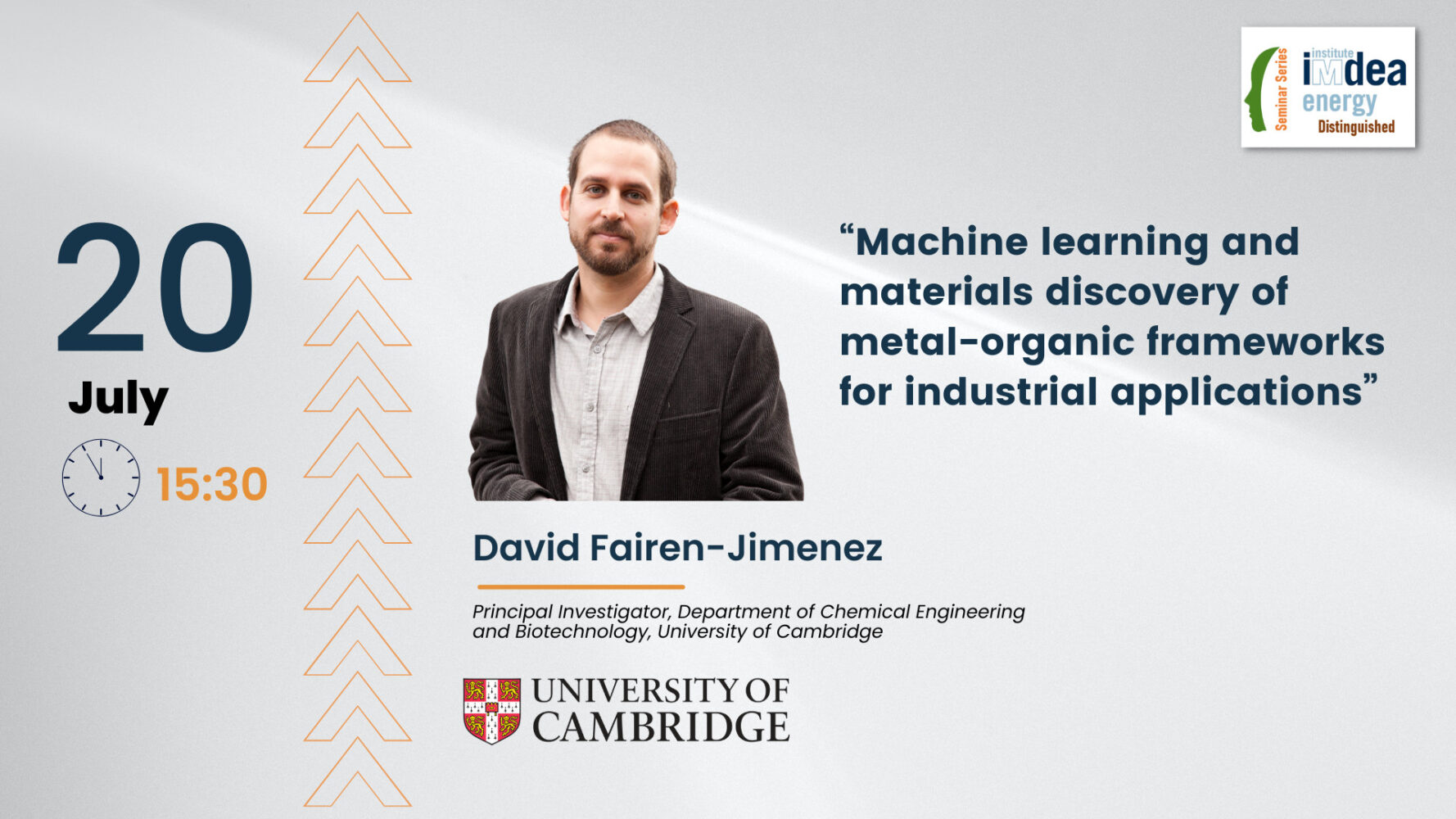
David Fairen-Jimenez is Professor of Molecular Engineering at the University of Cambridge, where he leads the Adsorption & Advanced Materials Laboratory (A2ML) in the Department of Chemical Engineering and Biotechnology. His research sits at the interface of materials science, chemistry, molecular engineering and medicine, with a particular focus on the design, synthesis and translation of metal-organic frameworks (MOFs) and other porous materials for societal challenges.
Over the past 15 years, Professor Fairen-Jimenez has established a research programme spanning carbon capture, hydrogen storage, gas separations, and drug delivery. His group combines advanced materials synthesis with computational modelling, machine learning and in vivo validation to accelerate the discovery and translation of next-generation porous materials.
Alongside his academic career, Professor Fairen-Jimenez is an active entrepreneur committed to translating fundamental research into real-world technologies. He is Founder and Chief Scientific Officer of Immaterial, a company commercialising monolithic MOFs for industrial carbon capture and hydrogen storage, and Founder and Chief Scientific Officer of Vector Bioscience Cambridge, which is developing first-in-class porous NanoShuttles for targeted delivery of therapeutics, including macromolecules. These ventures build on technologies developed in his laboratory and reflect his commitment to bridging academic excellence with commercial impact.
Abstract
“Machine learning and materials discovery of metal-organic frameworks for industrial applications”
The building-block approach to the synthesis of metal-organic frameworks (MOFs) has opened the possibility to synthesise a virtually infinite number of these materials. This creates exciting opportunities but also raises the question of how to identify and classify MOFs among the plethora of existing crystal structures. At the same time, experimental trial-and-error discovery of MOFs is not fast enough for their commercialisatrion and, therefore, new methods accessible not only to computational researchers but mainly to experimentalists need to be developed. Given the flexibility offered by MOFs and similar reticular materials, we identify two critical questions: can we find a deterministic prediction for materials performance? And, can we translate these predictions to real materials and commercial applications at scale?
To help with the first problem, we have developed a curated database containing all the MOFs deposited in the Cambridge Structural Database (CSD). This initiative provides the MOF community with tools to extract their desired structures from the pool of crystalline structures in the CSD and to visualise their data of interest. This has resulted in a regularly updated CSD-MOF subset of more than 130,000 structures to date. With this tool, we have also demonstrated the power of the MOF subset for computational high-throughput screening (HTS), where we analyse their performance in different applications – using machine learning capabilities to predict future materials in energy and healthcare applications.