
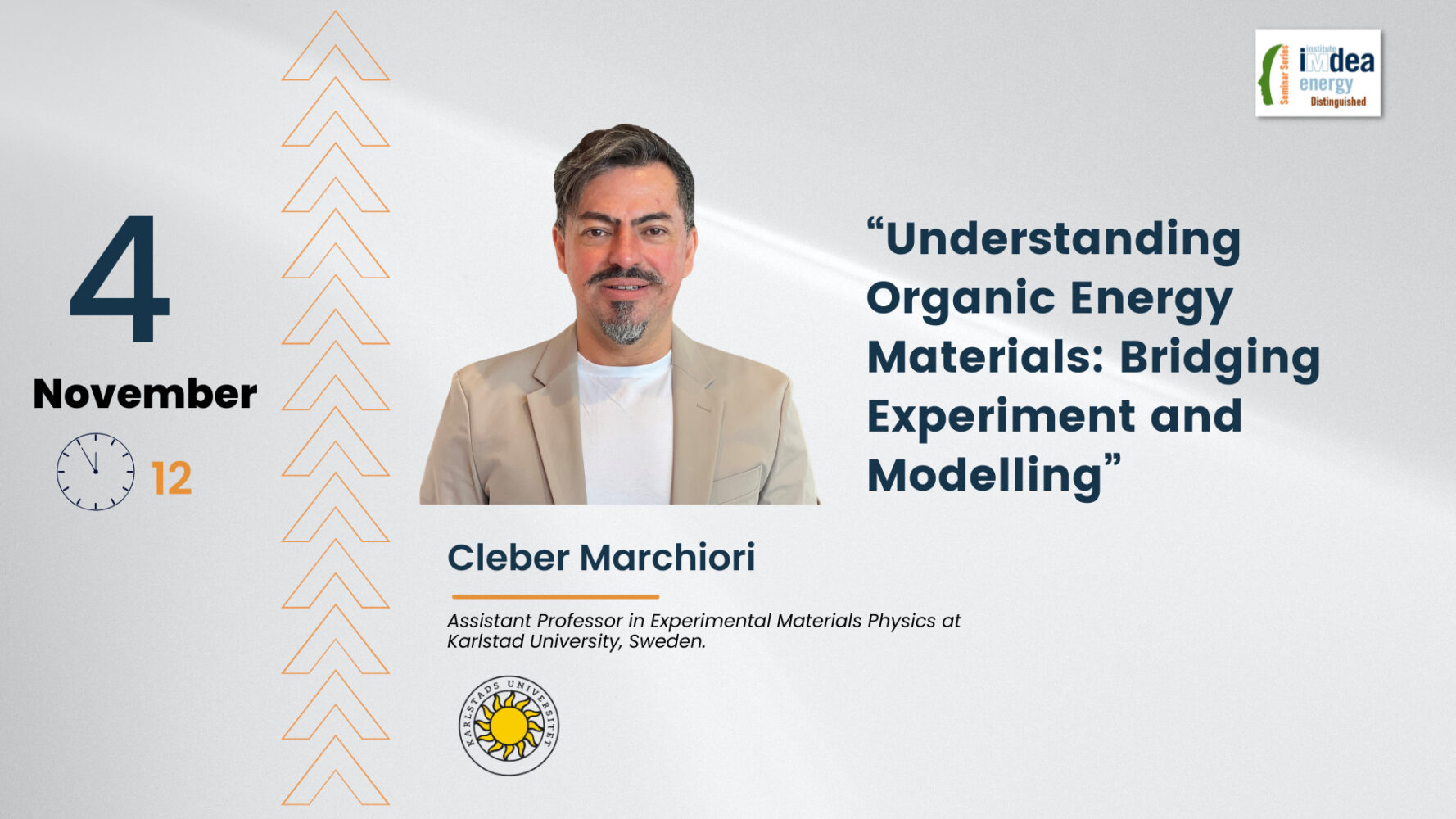
Distinguished Seminar: Understanding Organic Energy Materials: Bridging Experiment and Modelling
Abstract
Understanding the relationship between molecular structure, electronic properties and function is central to the development of organic materials for energy conversion and storage. Yet, the complexity of these materials often makes it difficult to obtain a complete microscopic picture from either experiment or modelling alone. In this seminar, I will discuss how advanced spectroscopic characterization and atomistic modelling can be combined to address this challenge across different classes of organic energy materials.
Examples from organic semiconductors will illustrate how X-ray absorption and photoelectron spectroscopies, together with electronic-structure calculations, can provide complementary information on molecular orientation, electronic states and ultrafast charge-transfer processes. Particular attention will be given to how experimental and theoretical quantities should be compared when describing fundamental properties such as the energy gap, and to the limitations of isolated-molecule descriptions when intermolecular interactions, structural disorder and the surrounding environment become important.
I will then discuss how the theoretical description can be progressively extended from molecular calculations to crystal-structure prediction and multiscale approaches combining molecular dynamics and quantum-mechanical calculations. Such approaches make it possible to connect experimentally observed properties with the atomic-scale structure of crystalline as well as solution-processed disordered materials.
Such approaches make it possible to connect experimentally observed properties with the atomic-scale structure of crystalline and solution-processed disordered materials, with applications ranging from organic semiconductors to electrochemical energy-storage materials.
Short bio
Cleber Marchiori is Assistant Professor in Experimental Materials Physics at Karlstad University, Sweden. His research focuses on the electronic structure and physicochemical properties of organic and molecular materials for energy applications, with particular emphasis on advanced X-ray spectroscopies and the combination of experimental characterization with atomistic and electronic-structure modelling.
His experimental work makes extensive use of synchrotron radiation techniques, including X-ray photoelectron spectroscopy (XPS), near-edge X-ray absorption fine structure (NEXAFS) spectroscopy and resonant photoelectron spectroscopy (ResPES), to investigate electronic structure, molecular organization, charge-transfer processes and degradation in organic energy materials. His research has involved experiments at several synchrotron facilities, including MAX IV, SOLARIS and Sirius.
A recurring theme of his research is the close integration of experiment and theory, ranging from density-functional and excited-state calculations used to interpret spectroscopy to atomistic and multiscale approaches for complex materials. He has worked on organic semiconductors, photovoltaic materials, organic battery electrodes and polymer electrolytes, with the broader aim of establishing structure–property relationships that can guide the development of functional materials for sustainable energy technologies.