

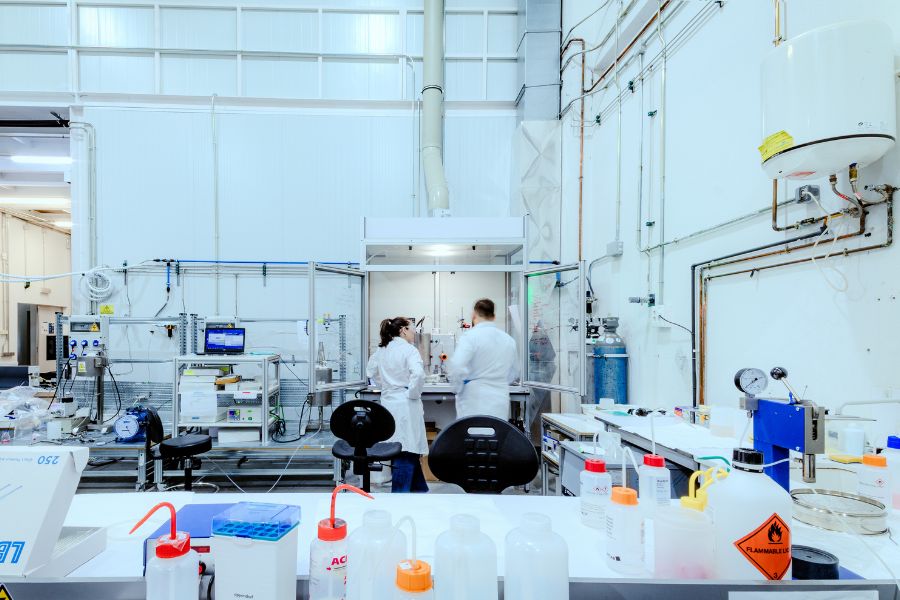
IMDEA Energy drives industrial-scale production of renewable chemicals from biomass and vegetable oils
Researchers at the IMDEA Energy Institute have developed a new process to produce aromatic hydrocarbons more efficiently from biomass and vegetable oils instead of petroleum. These compounds are key building blocks for the chemical industry and are used in the manufacture of plastics, solvents, and fuels.
The study, published in the scientific journal Chemical Engineering Journal, addresses one of the major challenges associated with this transformation: the catalysts used to convert biomass into these compounds tend to become fouled very quickly and lose their effectiveness, making large-scale implementation difficult.
The study’s main finding is that combining low-temperature biomass pyrolysis with the subsequent co-processing of vegetable oils over a ZSM-5 zeolite catalyst makes it possible to obtain higher yields of valuable aromatic compounds while significantly extending the catalyst’s lifetime.
The key: combining two strategies
The research team combined two complementary techniques to overcome this challenge. First, wood or agricultural residues are decomposed at a lower temperature than usual, which helps prevent the formation of substances that foul the catalyst. Non-edible vegetable oils are then co-fed into the process, helping the reaction produce larger quantities of higher-quality target compounds.
Experiments conducted using oak wood and wheat straw showed that this combination can produce nearly three times as many aromatic hydrocarbons as conventional methods. In addition, the catalyst takes up to eight times longer to lose its activity, reducing the frequency with which it needs to be replaced or regenerated and bringing the process closer to potential large-scale application.
Economic and environmental benefits
The study also includes a preliminary economic and environmental assessment, which indicates that the process could generate higher revenues per tonne of feedstock processed than conventional alternatives, thanks to the high value of the compounds produced.
—
Article reference:
Pagano, M., Abelleira, S., Iribarren, D., Dufour, J., Cueto, J., Moreno, I., Serrano, D.P. (2026). Overcoming major challenges in lignocellulose catalytic pyrolysis by combination of low-temperature thermal decomposition and co-processing with vegetable oils over ZSM-5 zeolite: boosted production of aromatic hydrocarbons and prolonged catalyst lifetime. Chemical Engineering Journal, 547, 181049. https://doi.org/10.1016/j.cej.2026.181049